

8 min read
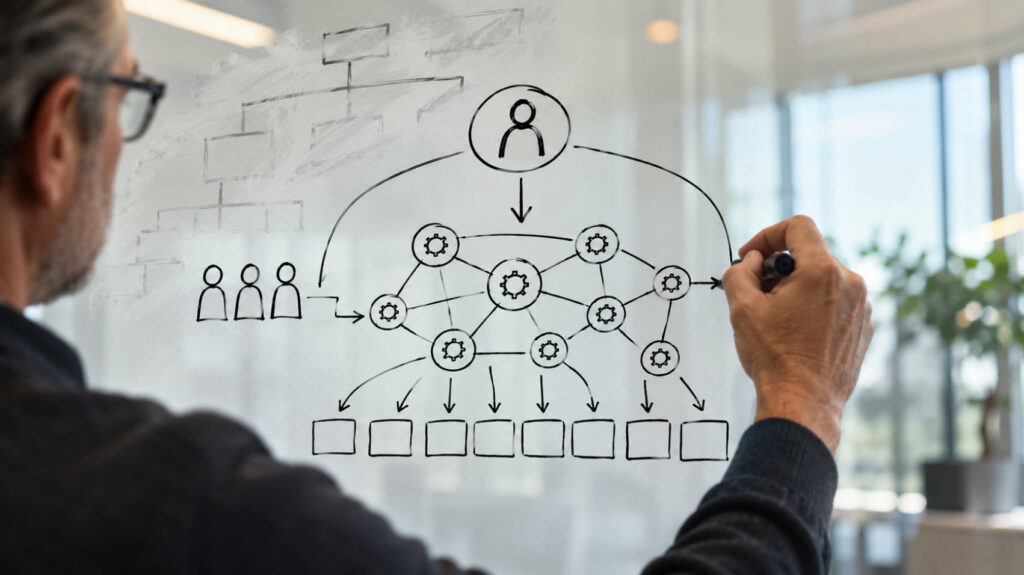
AI agents may eventually allow just a few people to accomplish what once required entire teams, including much of the specialized knowledge, coordination, and decision-making. But what happens when those agents make a serious mistake, such as a security breach exposing millions of customer records? Who is accountable? The number of people needed to operate an organization may shrink dramatically, but its responsibility for the outcomes doesn’t. Accountability doesn’t necessarily require constant human intervention.
A recent LinkedIn post by Rich Allen, author of User Needs Mapping, about AI agents and Team Topologies prompted me to revisit a topic I’ve written about before: how we view AI agents as organizations increasingly incorporate them into everyday work. Like Rich and others exploring this topic, my perspective keeps evolving through these industry conversations and the questions they raise.
Rich makes an interesting distinction between organizational capabilities, the teams responsible for them, and the AI agents that help deliver them. He argues that an AI agent isn’t an organizational team, even when it performs work that previously required several people or teams.
In my recent article, Are We Repeating Our Leadership Mistakes at AI Speed?, I shared a principle I’ve emphasized throughout our AI adoption efforts: AI reduces task effort, not responsibility.
That reflects much of what we’re experiencing today. People are increasingly directing agents to perform work, but they still need to understand the results, make decisions, and remain accountable.
Rich’s post, along with an example I came across this week, got me thinking about where this might lead. What happens when agents can also take on much of the specialized knowledge, judgment, and oversight we currently rely on people to provide?
If AI agents let one person do work that previously required four people, what happens to the responsibilities and accountability those four people carried?
We’ve Seen Something Similar Before
Consider manufacturing automation.
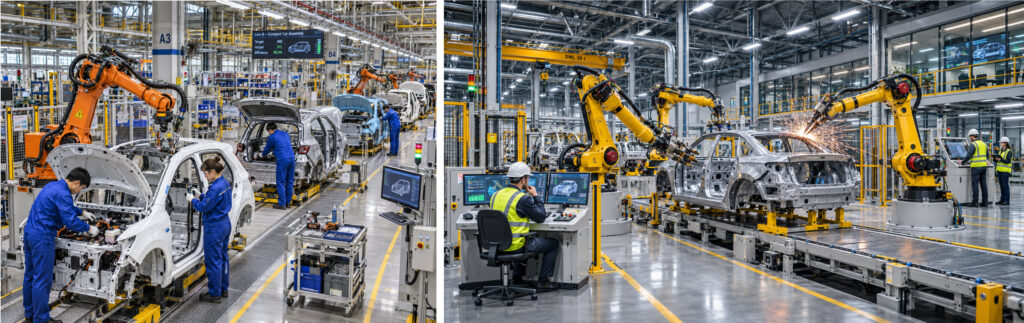
In an automotive factory, industrial robots perform welding, assembly, inspection, and other activities that once required multiple workers. Automation has dramatically changed how factories operate and how many people are needed.
But we don’t consider those robots members of the manufacturing team.
People remain accountable for production, quality, safety, and ultimately the outcomes. The robots perform work within a system designed, operated, and governed by people.
AI takes this further. Unlike traditional industrial robots, increasingly capable agents can analyze information, evaluate results, make decisions, and coordinate other agents.
We’re potentially automating much more than execution. We’re also automating the knowledge, judgment, and coordination that previously required people.
What Happens to Our Product Teams?
At my previous organization, we had 11 teams supporting eight products. We organized around product value streams, supported by platform and enabling teams, following principles similar to Team Topologies.
Our cross-functional product teams generally had seven to nine people, bringing together the capabilities needed to build, deliver, and support their products end to end.
Now imagine three people, supported by a fleet of AI agents, could accomplish what those 11 teams previously delivered.
Would we still have 11 teams? Eight product teams? Or three people operating an automated software delivery system?
The products would still exist, along with their customers, business objectives, technical dependencies, and operational responsibilities.
We might organize agents around individual products, platform services, or specialized capabilities. They could communicate, coordinate, and perform work across those boundaries.
But grouping automated work doesn’t necessarily make those groups organizational teams.
What If AI Provides the Specialized Expertise Too?
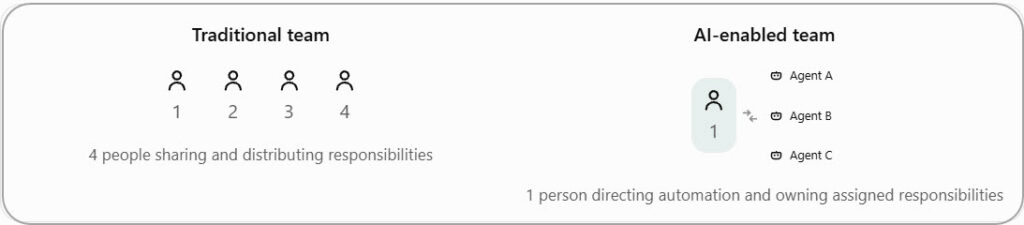
Imagine a team of four people with expertise in product management, software engineering, security, and quality engineering.
AI agents may eventually perform most of the work across all four disciplines.
My initial concern was whether the one remaining person would have the knowledge and judgment to evaluate everything those agents produced.
Could a software engineer adequately assess an agent’s product recommendations, recognize a security vulnerability, evaluate quality risks, and make appropriate release decisions?
But perhaps that question is rooted too heavily in how we operate today.
What if AI provides much of that specialized judgment too?
Product agents could research markets, analyze customer behavior, develop hypotheses, and evaluate business outcomes. Engineering agents could design, build, and maintain software. Security and quality agents could continuously evaluate the work, identify risks, and initiate corrective actions.
Other agents could independently assess those decisions, monitor performance, and coordinate improvements.
The remaining human wouldn’t necessarily need all the specialized expertise previously distributed across four people.
Of course, agents evaluating other agents doesn’t automatically guarantee reliable results. We still need effective controls, independent validation, and ways to identify when the system is getting something wrong. But increasingly, those safeguards may also be automated.
What Happens to Cognitive Load?
Team Topologies places considerable emphasis on managing cognitive load. We establish team boundaries and provide platform capabilities partly because people have limits on how much information and complexity they can manage.
I’ve supported these principles for years.
But what happens when AI can absorb much of that cognitive load?
If agents can retain context, manage dependencies, coordinate work, evaluate results, and escalate only decisions that require human attention, the number of products a small group of people can oversee may increase dramatically.
Perhaps three people supporting eight products becomes entirely reasonable, or even fewer in some organizations.
Complexity doesn’t necessarily disappear, but more of it may be managed within the automated system.
The point of diminishing returns could also move. Instead of being constrained primarily by human capacity, organizations might become constrained by the cost of automation, the reliability of autonomous decisions, or their ability to create meaningful business value.
We’re Already Seeing AI-Native Models Emerge
This week, I came across an interesting example from Jacob Sansbury, founder of Spawn, a multiplayer gaming startup.
In his October 29 post, Jacob describes an organization of 10 people working alongside a persistent fleet of AI agents. According to his account, those agents work across engineering, operations, finance, and other functions, delivering about 77,000 substantial software changes in 30 days.
Those figures are self-reported, but the operating model is worth a closer look.
What caught my attention was how Jacob describes agents as owning areas of the company, with human involvement increasingly focused on vision and direction.
I understand that description from an execution perspective. Agents can have ongoing responsibilities, make decisions within defined boundaries, and coordinate work without constant human intervention.
But with Spawn reportedly spending $3.1 million a month on AI tokens, there’s also an economic question.
How much value is all that execution producing?
Shipping more changes is impressive, but understanding what those changes accomplish remains important, whether 100 engineers, 10 engineers, or a fleet of AI agents does the work.
What Happens When Something Goes Terribly Wrong?
Let’s return to my example of eight products supported by three people and a fleet of agents.
Imagine a catastrophic security breach that exposes millions of customer records, damages the company’s reputation, and puts customers at risk.
Perhaps an engineering agent introduced the vulnerability, a security agent failed to recognize it, and other agents approved and deployed the change.
Who is accountable?
In my previous organization, engineering managers, product leaders, platform engineering, security, and executive leadership shared responsibility. Accountability was distributed across defined roles, with ultimate organizational responsibility resting with the company and its leadership.
In the three-person organization, most of those roles might no longer exist.
But the company still has the same obligations to its customers.
As I’ve said before, you can’t take an AI agent to court, at least not today.
The organization remains answerable for what its systems do. The CEO, CTO, or other designated leaders are still accountable for the areas under their authority, even if they never personally reviewed the code or approved the deployment. That doesn’t automatically make any individual legally liable, but automation doesn’t erase their responsibilities either.
And I don’t believe the answer is to require humans to review every decision an agent makes. That would undermine much of what makes autonomous systems valuable.
Instead, accountability increasingly depends on how the organization sets boundaries, validates its automated systems, manages risk, and responds when things go wrong.
The CTO may no longer oversee 11 engineering teams. But that person could be responsible for an autonomous engineering operation making thousands or millions of decisions.
The number of people may shrink dramatically, while the scope of their accountability remains just as significant, or even increases.
Start With Responsibilities
I recently wrote about starting with responsibilities before designing organizational roles. I believe that principle becomes even more important as AI changes how we work.
We should understand what capabilities and responsibilities the organization needs, then determine how people and automation can fulfill them.
That may mean fewer traditional teams and fewer people making specialized decisions. We shouldn’t assume today’s roles and structures need to remain simply because they’ve worked in the past.
But we should distinguish between performing work, making decisions, and being accountable for the outcomes.
We already understand this in traditional organizations.
A CEO is accountable for organizational performance without personally reviewing every operational decision. Leaders delegate work, establish expectations, implement controls, and evaluate results.
Why couldn’t we extend similar principles to AI agents?
The difference is that delegation to AI may eventually cover nearly all operational activities, including much of the oversight itself.
The challenge becomes establishing sufficient confidence that the autonomous system operates within acceptable boundaries and delivers the intended outcomes, without requiring constant human involvement.
Are We Redesigning Accountability Alongside Automation?
For me, it raises a broader question about what organizations might look like when AI performs not only the work, but also much of the coordination, evaluation, and decision-making.
If three people supported by agents can accomplish what previously required 11 teams, that would be an extraordinary change in how we deliver software.
We shouldn’t assume we need to preserve organizational structures and management practices designed around human limitations.
But we also shouldn’t assume that reducing human involvement reduces the organization’s responsibility for the consequences.
The need for accountability doesn’t necessarily require constant human intervention.
Are we redesigning accountability as thoughtfully as we’re automating the work?
Related Articles
- Are We Repeating Our Leadership Mistakes at AI Speed? – November 1, 2026
- AI Can Shrink Your Team. It Cannot Shrink the Work – May 22, 2026
- From Two Pizzas to One: How AI Reshapes Dev Teams – October 2, 2025
- AI Is Changing Management, Not Reinventing It – July 27, 2026
- AI Graph Engineering Looks Familiar for a Reason – August 4, 2026
- The AI Didn’t Sign Your IP Agreement – July 11, 2026