

3 min read
From Flow to Realization – Part 1 of 3
Outcomes seem to be getting much more attention in the digital delivery conversation today.
It made me revisit a post I wrote in February 2023, when I was beginning to question my own focus on delivery efficiency and flow.
I was having a conversation with a CEO I called “Steve” about how we measure whether engineering teams are improving.
I gave him a simple example:
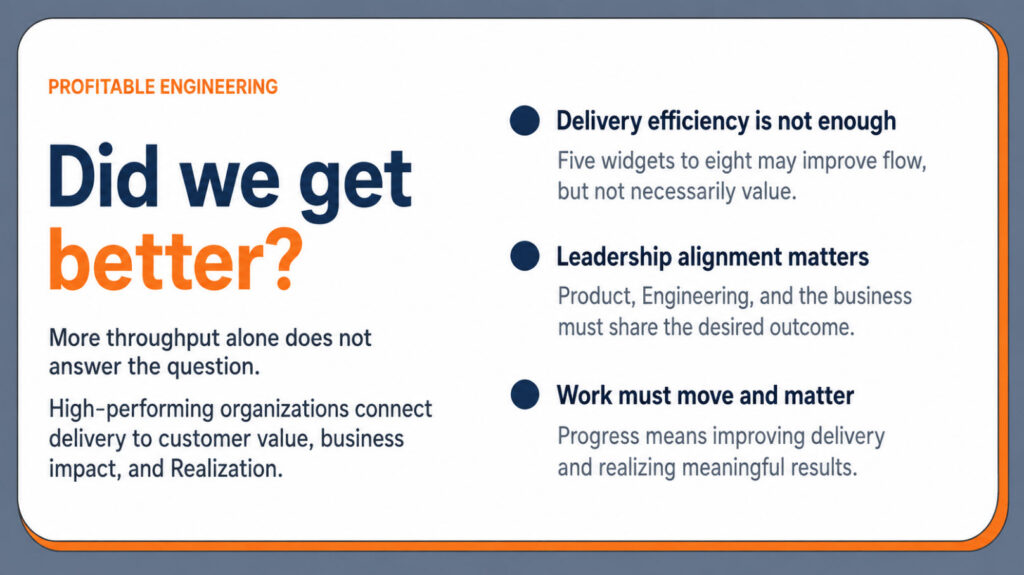
“What if a team could improve from delivering five widgets per week to eight, with the same number of team members and the same number of hours?”
I asked, “Did we get better?”
His answer was yes.
Mine was increasingly becoming “I don’t know.”
“How will we know that we are building the right things?”
“How will we know that we have not overproduced and wasted time?”
Those additional three widgets might represent greater delivery efficiency. But if they do not create the expected customer or business value, what exactly did we improve?
I also haven’t forgotten something else Steve said during that conversation: it wasn’t my job as the VP of Engineering to question or know the value of the work. That was the responsibility of the senior Product leader to determine and communicate.
That stuck with me.
Because this is exactly the kind of leadership and organizational misalignment I think we have to examine when we ask why Agile transformations, product transformations, or other efforts fail.
If Product understands the value, Engineering understands the delivery system, and the business understands the desired outcome. Still, those things remain separated by organizational boundaries; we haven’t really created an aligned system of work.
That conversation became an important shift in my thinking.
Flow still mattered. Delivery performance still mattered. But I was beginning to understand that improving the delivery system was only part of the responsibility.
We also needed a shared understanding of the purpose of the work, the outcome we expected, and whether anything meaningful was actually achieved.
My takeaway in 2023 was:
“Only then can we genuinely answer if we are making progress and delivering the right things.”
Three years later, much of the industry is organizing around outcomes, and this thinking eventually became a central part of Profitable Engineering:
Work has to move. But it also has to matter.
So who owns the outcome in your organization, and do the people doing the work actually understand what that outcome is?
This is Part 1 of a three-part series, From Flow to Realization, exploring how my thinking evolved from improving the flow of digital work to understanding whether that work actually creates the intended customer and business outcomes.
In Part 2, I look at the operating principle that followed from that realization: start with the anticipated outcome, then work backward.
About the Author
Phil Clark is a technology executive, advisor, and author of Profitable Engineering: Transforming Technology Teams Into Strategic Business Partners (profitableengineering.com). His work focuses on helping leaders connect software delivery, operating discipline, and AI adoption to measurable business value.
Related Articles
- Maximizing Technology Team Performance: Insights from a CEO Conversation, https://rethinkyourunderstanding.com/maximizing-technology-team-performance-insights-from-a-ceo-conversation/, February 16, 2023.