

From Flow to Realization – Part 2 of 3
This week, across two group video conversations with leaders who have spent years working in Flow, Value Stream Management, Lean, DevOps, and organizational transformation, the same theme kept surfacing.
The conversation turned to something many of us have been thinking about lately.
For years, much of our industry has focused on how digital work moves through an organization. More recently, the conversation has been shifting toward outcomes.
Did the work matter? Did it improve something for the customer? Did it create measurable value for the business?
One thing I have appreciated since publishing Profitable Engineering is how often this same discussion keeps coming up. Different authors, frameworks, and communities, but increasingly we seem to be arriving at a similar place.
I tried to capture it in the book with one simple statement:
“Work has to move. But it also has to matter.”
That is the relationship between Flow and Realization. And now AI is making the outcome question harder to avoid.
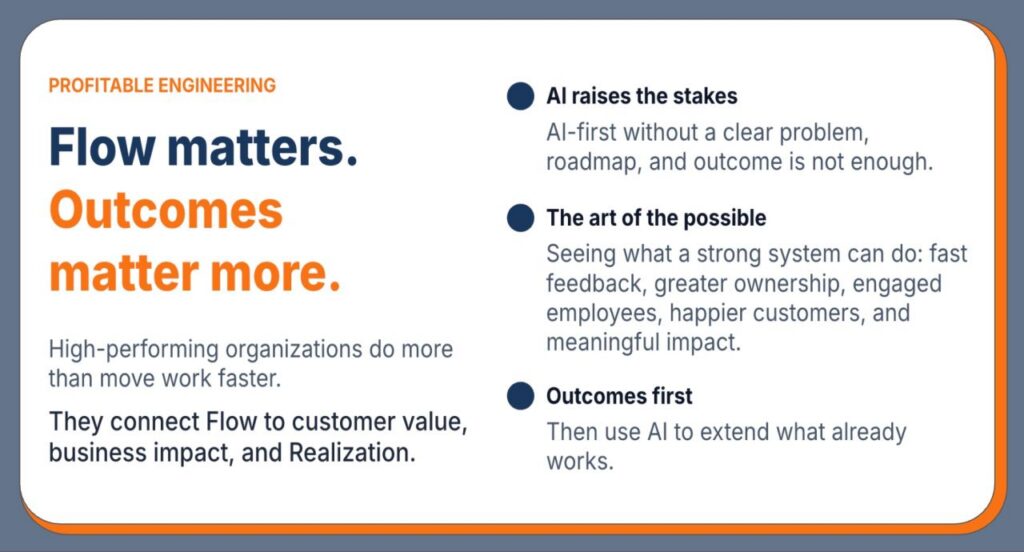
Across both conversations, the same AI issue surfaced: organizations can become AI-first before they are clear on the problem or desired outcome.
One participant framed it well: own the problem space first, then ask how AI can help solve it better.
AI creates urgency. Outcomes give it direction.
Then the host asked another question that stuck with me: So many of us have been talking about these ideas for years, and so many organizations still struggle to realize the benefits. Why do we keep trying?
My answer was what I often call the art of the possible.
Once you have worked in a genuinely high-performing team and organization that can compete with, and sometimes outperform, the best in the industry, you do not want to work any other way.
You experience fast feedback. People see the impact of their work. High performers stay. Employees are more engaged. Customers are happier. Teams have greater ownership. The organization responds faster when things change.
It is never perfect. But once you have experienced what a high-performing organization can do, it becomes difficult to accept persistent dysfunction as simply the way work has to be.
AI makes that even more interesting. It gives us better ways to analyze how work happens, surface patterns we may have missed, and strengthen the evidence behind our decisions. Agent team members can also take on parts of the work that used to sit entirely with people.
That is where AI gets exciting: not replacing a mature way of working, but extending what an already strong system can do.
That is why many of us keep trying.
We have seen the art of the possible. We know work can move and matter.
This is Part 2 of a three-part series, From Flow to Realization, exploring how my thinking evolved from improving the flow of digital work to organizing work around the outcomes we expect it to create.
In Part 3, I look at why so many of us continue trying to build high-performing organizations, and how AI may extend what already strong systems are capable of doing.
About the Author
Phil Clark is a technology executive, advisor, and author of Profitable Engineering: Transforming Technology Teams Into Strategic Business Partners (profitableengineering.com). His work focuses on helping leaders connect software delivery, operating discipline, and AI adoption to measurable business value.
Related Articles
- Eight Widgets Instead of Five. Did We Actually Get Better?, https://rethinkyourunderstanding.com/eight-widgets-instead-of-five-did-we-actually-get-better/, August 13, 2026.