

3 min read
From Flow to Realization – Part 3 of 3
Outcomes are becoming a much bigger part of the digital delivery conversation.
For many organizations, that makes sense. Years of transformation work focused heavily on improving digital delivery, culture, flow, speed, quality, and efficiency. Now the harder question is gaining more attention: what did all of that work actually change?
That realization began to take shape for me in early 2023 during a conversation with a SaaS CEO. But it was really in 2024, after we had significantly improved the flow of our delivery system, that I started putting the pieces together to organize the work itself around outcomes. This was one of the catalysts for writing Profitable Engineering.
The idea itself is not new. I remember conversations with Steve Pereira about Flow Engineering and starting with the outcome and working backward, Amazon’s approach in Working Backwards, and others making a similar case. Mik Kersten and I were also writing about this shift from different perspectives, something neither of us was aware of until we caught up at a conference late last year. We both ended up publishing books on similar themes this summer.
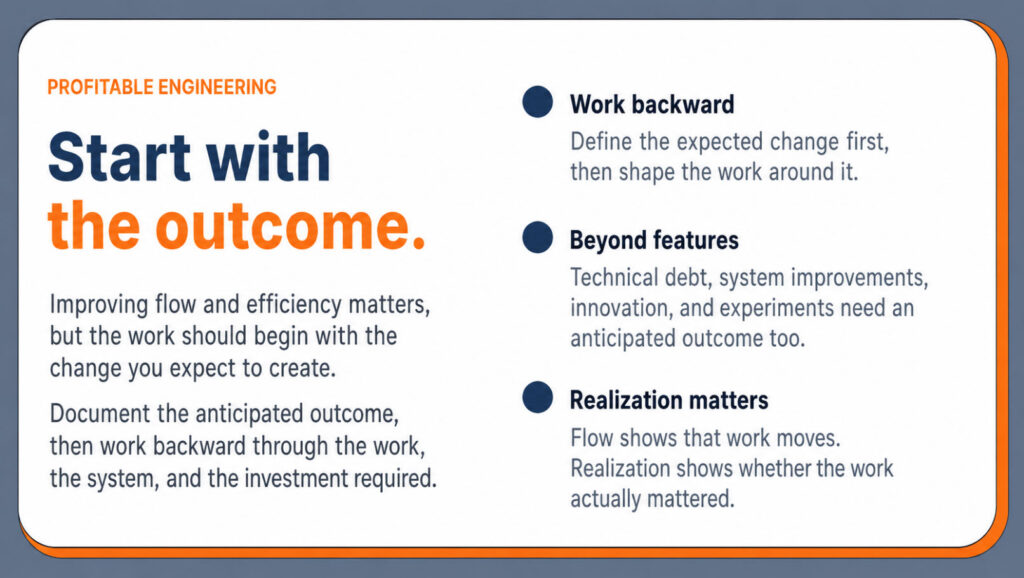
Start with the anticipated outcome. Document it. Align the outcome to higher-level goals or outcomes. Then work backward.
If you cannot explain what you expect to change and why it matters, why are you doing the work?
And this applies well beyond features. Technical debt, system improvements, innovation, and experimentation should also start with an anticipated outcome.
Improving flow and efficiency matters. Realization is ultimately why the work matters.
How often does your organization start with the outcome, work backward to determine the work, and clearly communicate to the team why it matters?
This is Part 3 of a three-part series, From Flow to Realization, exploring how my thinking evolved from improving the flow of digital work to understanding whether that work actually creates the intended customer and business outcomes.
In Part 2, I look at the operating principle that followed from that realization: start with the anticipated outcome, then work backward.
In Part 1, I revisit the moment I began questioning whether improving delivery efficiency actually meant we were getting better if the work was not creating the intended customer or business value.
About the Author
Phil Clark is a technology executive, advisor, and author of Profitable Engineering: Transforming Technology Teams Into Strategic Business Partners (profitableengineering.com). His work focuses on helping leaders connect software delivery, operating discipline, and AI adoption to measurable business value.
Related Articles
- Eight Widgets Instead of Five. Did We Actually Get Better?, https://rethinkyourunderstanding.com/eight-widgets-instead-of-five-did-we-actually-get-better/, August 13, 2026. Part 1.
- Why We Keep Trying: The Art of the Possible in Digital Delivery, https://rethinkyourunderstanding.com/why-we-keep-trying-the-art-of-the-possible-in-digital-delivery/. Part 2.