• Skip to primary navigation
  • Skip to main content
Rethink Your Understanding

Rethink Your Understanding

Transforming Software Delivery

  • Home
  • Mission
  • Collaboration
  • Posts
  • Podcast
  • Endorsements
  • Resources
  • Contact

Value Stream Management

When the System Fits, the Product Operating Model Works

November 27, 2025 by philc

9 min read

In every conversation about product delivery, team structures, and operating models, one pattern always stands out: there is no single correct structure for a modern software organization.

Leaders make decisions based on their architecture, constraints, history, and the goals they want to achieve. That is why we see so much variation across companies. Some organizations thrive with smaller, long-lived, self-managed cross-functional teams aligned to clear domains. Others depend on larger engineering manager-led groups, shared capability teams, or more centralized arrangements. These differences are not failures. They are the result of leaders shaping systems around their specific context.

My own experience has shown the strength of a particular combination: small, autonomous, cross-functional, long-lived product teams operating within a clear boundary, supported by Team Topologies thinking, Agile practices, DevOps and continuous delivery, Value Stream Management, and the Product Operating Model.

When these elements align with the architecture and constraints of the environment, they create clarity, flow, and accountability. When they do not, the same practices that thrive in one environment can struggle in another. The operating model only performs when the system beneath it supports it.

That is why I appreciated Thorsten Speil’s recent LinkedIn article on the Product Operating Model. He captured many of its strengths and also surfaced the areas where interpretation varies, including team size, organizational implications, discovery practices, and the broader operational impact of shifting to a product-oriented way of working. His post brought these nuances back into focus and highlighted how easily good ideas get misunderstood once they spread across different companies and contexts.

Two themes resurfaced during the discussion. They do not reflect issues with Thorsten’s article, but they are common points of confusion across the industry and worth exploring more deeply.

Misunderstanding 1: Marty Cagan is recommending larger teams

This belief usually comes from surface-level summaries rather than the substance of the work. In his book Transformed, Marty Cagan does not argue that big teams are inherently better. He is arguing against dividing teams into narrow technical slices that leave them unable to deliver value without coordinating across several other groups.

When a team owns only a small fragment of the flow, such as just the UI or database layer, its success depends on the progress of others. Ownership becomes diluted, and dependencies increase.

The real question is not whether a team is “small” or “large.” It is whether the team owns a complete slice of value: a domain or subdomain, or a coherent value stream, that it can deliver with minimal coordination.

In the organizations I’ve worked with, when we refactored monolithic or tangled systems and clarified domain boundaries, teams often became smaller, not larger, but crucially, they became whole and autonomous. What changed was their completeness, not just headcount.

What really determines the right team design is context, the architecture, domain boundaries, cognitive load, subject-matter expertise requirements, and the way work and value flow across the system.

If a subdomain or product in a portfolio is large enough and demands sustained work, a dedicated team may make sense. If several small subdomains or products share architecture or customer value, a single team or squad covering them together can reduce overhead. Team size and structure should align with system boundaries and value streams, not arbitrary org chart conventions.

Misunderstanding 2: The Product Operating Model replaces DevOps

These two ideas are sometimes mentioned together, but they address different layers of the organization.

DevOps improves the path from code to production. It strengthens feedback loops, automation, stability, and the ability to release safely and frequently. The Product Operating Model influences how decisions are made, how work is funded, how discovery and delivery are structured, and how teams are aligned to outcomes. It governs how strategy flows into teams.

One is about delivery performance. The other is about organizational direction. They are not interchangeable, and in a healthy system, they support each other. DevOps allows teams to learn quickly and respond rapidly. The Product Operating Model ensures that this capability is being applied to the right opportunities.

When organizations confuse the two, they end up with teams that can ship quickly but have no clarity on why, or teams that are empowered in theory but constrained by an outdated delivery path.

Where Value Stream Management fits

One of the most overlooked parts of the conversation is the role of Value Stream Management. Many organizations adopt the Product Operating Model with the right intentions, but without visibility into how work actually flows today. Value Stream Management provides that visibility. It shows where work gets stuck, where dependencies cluster, where priorities conflict, and where delays originate. It is the mechanism that connects architecture, team boundaries, and the customer journey into a single picture.

Without this visibility, a product-aligned structure becomes guesswork. Leaders cannot see the real bottlenecks, and teams cannot understand why autonomy feels out of reach. Flow metrics reinforce this visibility by making delays, load, efficiency, and distribution measurable. When VSM, flow metrics, and POM reinforce each other, teams gain stability and clarity. Ownership becomes real rather than symbolic.

The Product Operating Model also changes how work is funded

Another important idea that often gets overlooked is the shift in funding. The Product Operating Model is not simply a structural or cultural change; it changes how work is supported economically.

Instead of funding projects on an annual cycle, organizations fund products and the teams responsible for them. Teams are long-lived rather than assembled and disbanded. Prioritization is continuous rather than fixed once a year.

Outcomes replace scope as the primary measure of progress, and domain expertise becomes a long-term asset. Stable teams and stable funding reinforce each other and create an environment where real ownership and long-term accountability can thrive.

Architecture enables team autonomy

It is common to talk about rapid delivery, continuous discovery, and empowered teams, but none of these is possible unless the architecture supports them.

If components are tightly coupled, if deployments require several approvals, or if core systems or data are shared among many teams, autonomy becomes difficult to implement regardless of intention. Organizational charts cannot compensate for technical constraints.

The most effective team topologies emerge from systems with clear domain boundaries, separation of concerns, modularity, and platform capabilities that reduce cognitive load. When architecture and team design reinforce each other, teams can own outcomes. When they conflict, coordination overhead grows, and autonomy becomes harder to achieve.

Architecture choices shape, but do not dictate, the model

I often advocate for distributed systems and microservices because they reduce dependency load and allow teams to operate with greater independence. But that does not mean these architectures are right for every organization. Modular monoliths, macroservices, domain-oriented monoliths, and hybrid models can all support effective product teams when their boundaries are clear and consistent.

What matters most is that the architecture supports meaningful ownership. I have seen monolithic systems with strong modular structure outperform poorly partitioned microservices because the boundaries were more deliberate.

The Product Operating Model does not require microservices. It requires coherent ownership aligned with the architectural reality.

A monolithic system can still operate effectively under a Product Operating Model when teams have clear ownership boundaries. The fundamental idea behind the Product Operating Model is organizing around outcomes and customer value rather than technical layers.

Teams need responsibility for a meaningful, end-to-end part of the product, not just a narrow slice of the stack. When a monolith is structured with deliberate domain separation and disciplined layers, teams can still take ownership of specific product areas or value streams and make decisions within those boundaries.

At the same time, monolithic systems often introduce more coordination requirements. Shared code paths, tightly coupled components, and synchronized releases can create friction and increase dependency load. These challenges do not prevent the Product Operating Model from working, but they require more intentional communication, clearer boundaries, and stronger agreements around how teams collaborate inside the monolith.

The architecture does not have to be perfect; it simply needs to support coherent ownership. The clearer the system’s internal structure, the easier it is for teams to operate end to end without excessive coordination.

This is why context matters. The Product Operating Model succeeds when the system enables teams to own outcomes, regardless of whether the underlying architecture is a monolith, a modular monolith, or a distributed set of services.

Why context matters

Organizations often begin by asking whether they should adopt the Product Operating Model. A better question is what their current system allows and where the real constraints are.

You can adopt a Product Operating Model in a monolithic architecture, and many companies do. What matters most is whether teams can own meaningful areas of the product, make decisions with limited friction, and deliver improvements without excessive dependencies. Some monoliths support this quite well, particularly when structured with clear domain boundaries. Others are so tightly coupled that autonomy is difficult until parts of the system are modernized.

The model itself is rarely the constraint. The system and its boundaries are. Most failed transformations happen not because the Product Operating Model is flawed, but because leaders apply it without understanding the environment that must support it.

The real work is creating the conditions for POM to succeed

Organizations that succeed with the Product Operating Model share several characteristics. Their architecture supports autonomy. Their value streams are visible. Flow metrics guide decisions. Team structures match real domain boundaries. DevOps practices are mature enough to support rapid learning and delivery. And product, design, and engineering operate together as one system.

In these environments, the Product Operating Model does not feel like a framework. It is the natural way the organization should operate. It aligns people, technology, and strategy into a coherent system and gives teams the conditions they need to take real ownership.

What Really Determines Whether POM Succeeds

Most debate about the Product Operating Model focuses on whether it is the right model. That is not the most helpful place to begin. The more important question is whether the system can support long-term product ownership and sustained team autonomy.

The Product Operating Model is not only a team structure. It is a commitment to funding products rather than projects, supporting teams for the lifespan of the product, building and retaining domain expertise, prioritizing work continuously instead of annually, and evaluating progress through outcomes rather than activity. When these elements are combined with modern architecture, visibility into flow, and strong DevOps practices, the Product Operating Model becomes a practical and natural way to operate. Teams can own their work end-to-end and connect what they build to real customer value.

When organizations attempt to adopt the model without making these underlying adjustments, POM struggles. Team boundaries feel artificial, ownership breaks down, and delivery becomes a ceremony rather than a learning experience.

The more productive question is not whether to adopt the Product Operating Model, but rather how to do so. The practical question is what needs to change in the architecture, the flow of work, the funding model, and the team design so that a product-oriented way of working can thrive in this environment.

Poking Holes

I invite your perspective on my posts. What are your thoughts?.

Let’s talk: phil.clark@rethinkyourunderstanding.com


References and Further Reading

This article draws on ideas and practices that have shaped modern product development, organizational design, and software delivery. For readers who want to explore the concepts more deeply, the following works provide useful context.

Thorsten Speil – “You need to move to the Product Operating Model! … Really?” (2025), https://www.linkedin.com/pulse/you-need-move-product-operating-model-really-whats-thorsten-speil-2mhcf/
The original post that inspired this article and sparked a thoughtful discussion on how organizations interpret and apply POM principles in different contexts.

Marty Cagan – Transformed (2024)
Clear articulation of the Product Operating Model and the organizational conditions needed to support empowered product teams.

Matthew Skelton and Manuel Pais – Team Topologies
Guidance on service-aligned team structures, interaction modes, cognitive load, and organizational boundaries that support flow.

Value Stream Management Consortium – Project to Product Reports (2023–2024)
Industry research on flow metrics, product funding, and how organizations connect technology investments to actual business outcomes.

Dr. Nicole Forsgren, Jez Humble, and Gene Kim – Accelerate
Evidence-based insights into DevOps, continuous delivery, feedback loops, and the capabilities of high-performing engineering organizations.

Steve Pereira and Andrew Davis – Flow Engineering
Practical mapping techniques for visualizing system constraints, dependencies, and opportunities to improve value flow.

Eric Evans – Domain-Driven Design
Architectural foundations for creating clear domain boundaries that support coherent ownership in product-aligned teams.

Filed Under: Agile, DevOps, Leadership, Product Delivery, Software Engineering, Value Stream Management

Why Value Stream Management and the Product Operating Model Matter (and What Comes Next)

November 5, 2025 by philc

6 min read

I had the opportunity to revisit my January article and refine its key points for a recent Flowtopia.io post.

Seeing the Why Behind the Frameworks

In 2021, as part of our evolving Agile transformation, I introduced Value Stream Management (VSM) and later championed the Product Operating Model (POM). Yet I never clearly articulated why these practices mattered.

Looking back, we had already been moving toward a product-oriented model long before naming it. Cross-functional product teams operated organically but without shared governance. When capacity pressures mounted, priorities blurred and inefficiencies surfaced, showing that alignment and communication of purpose are as essential as the frameworks themselves.

Inside my own organization, alignment lagged. Technology advanced rapidly, and engineers and Agile Leaders embraced flow metrics and value-stream thinking, while the product function remained loosely engaged. Without clear accountability, the message fractured: technology optimized for flow; product managed for capacity. The gap limited our ability to realize the frameworks’ potential.

This imbalance is common. Most organizations face more work than they have capacity for, making prioritization and a focus on outcomes essential. VSM and the Product Operating Model address this directly, aligning teams, optimizing workflows, and ensuring that every hour of capacity contributes to real value.

“Adopting frameworks isn’t enough; leaders must over communicate their purpose.”

The Turning Point: When Efficiency Isn’t Enough

Every transformation reaches a moment of truth. You automate more, deploy faster, and report higher output, yet business leaders still ask, “How are our investments being utilized?”

The disconnect isn’t about effort or talent, but about visibility. Most digital organizations struggle to clearly understand how knowledge work flows or how investments in Scrum, Kanban, DevOps, automation, and now AI impact performance. Teams, in turn, can’t see how their daily work ties to customer or business outcomes.

That’s where VSM and POM intersect, two complementary frameworks that connect flow, alignment, and outcomes. Both emerged from the same realization: efficiency alone is insufficient. Without linking how value flows to what outcomes it creates, organizations risk optimizing for motion instead of progress. Sustaining expertise and funding across a product’s lifespan, rather than through short-term projects, produces better results.

From Projects to Products

For decades, technology operated as a cost center measured by utilization and velocity. Projects were funded, staffed, delivered, and dissolved. The product model reversed that logic.

By aligning long-lived teams around customer and business outcomes, organizations create real ownership and continuity. Teams become responsible not just for delivery, quality, and security, but for the outcomes they produce.

Economic accountability strengthens this model. In a product-funded operating structure, long-lived teams contribute to sales and growth, but they also influence the margins those products generate. That requires understanding more than top-line revenue. Teams should know their cost of goods sold (COGS): the direct costs, licenses, labor, implementation effort, and other team expenses that determine the actual cost of delivering and supporting the product.

When teams are evaluated on margin contribution rather than throughput or feature count, the dynamic changes. Ownership deepens. The definition of value expands. Financial discipline becomes part of everyday decision-making.

This also creates new complexity. Accountability and funding are no longer as simple as “get the code out.” They become “deliver a product customers will buy, at a margin the business can sustain.” For many organizations, this is far harder than shipping features, especially when teams are short-lived, responsibilities overlap, or cost allocations remain unclear.

But this discipline is one of the most powerful levers for turning the Product Operating Model from a framework built for speed into one built for sustainable value. It does not push teams back into a cost-center posture. Instead, it gives them the visibility to understand how Flow, outcomes, and customer success connect directly to profitability.

In our case, context switching dropped. Developers embedded in single domains became accountable for both flow and customer outcomes. Priorities shifted faster, decisions stayed within teams, and purpose became clearer. When people see how their work creates value, metrics stop being abstract and become insights for improvements; they start to matter.

Context Is Everything

“There is no one-size-fits-all approach to transformation. The true power of frameworks like VSM and POM lies in their flexibility to serve as blueprints rather than rigid rules.”

Adoption succeeds only when frameworks align with an organization’s structure, culture, and leadership context. Models fail not by design but by misapplication. That’s why effective organizations start by seeing their system before changing it.

Value Stream Mapping provides visibility, showing how work moves, where it slows, and how efficiently it reaches customers. Flow Engineering practices, such as Outcome Maps, Current-State Maps, and Dependency Maps, enable leaders to visualize how work, teams, and dependencies interact. These visualizations reveal friction, conflicting priorities, and hidden handoffs that delay the realization of value.

“Visibility creates alignment. Alignment establishes the foundation for improvement.”

The 2024 Project to Product State of the Industry Report confirms that elite organizations don’t just implement frameworks; they adapt them to fit their structure and customer context. That adaptability turns adoption into transformation.

Flow and Realization: The Two Sides of Value

Every delivery system operates in two dimensions:

Flow – how efficiently value moves.

Realization – how effectively that value produces business or customer outcomes.

Most organizations measure one and overlook the other or treat them as separate conversations.

Flow metrics, including Flow Time, Velocity, Efficiency, Distribution, and DORA metrics, reveal system health but not its impact.

Realization metrics, retention, revenue contribution, and time-to-market, show outcomes but not efficiency.

“Flow transforms effort into movement; realization transforms movement into impact.”

The 2024 Project to Product Report found that fewer than 15% of Organizations integrate flow metrics with business outcomes. Yet those that do so outperform their peers on both speed and customer satisfaction.

Measuring Across Layers

Metrics operate across three layers:

• System Layer: Flow & DORA metrics reveal delivery efficiency.

• Team Layer: Developer Experience (DX) and sentiment show team health.

• Business Layer: Realization metrics link work to outcomes.

Connecting these layers turns measurement into meaning and prevents metric theater, reporting what’s easy instead of what matters.

Leadership and Structure: The Missing Link

Even the best frameworks fail without a shift in leadership. Adopting VSM and POM means transitioning from a command-and-control approach to one of clarity, from managing tasks to managing systems.

Delegation and empowerment become strategic levers. Leaders define and communicate outcomes and boundaries; teams own delivery, quality, and learning within them. Guided by data-driven feedback, they experiment and improve.

The best teams treat flow and realization as continuous feedback loops, a living system that evolves with every release.

Governance through transparency replaces micromanagement. Dashboards enable leaders to coach, rather than control, by focusing on flow, bottlenecks, and opportunities. Empowerment is a shared ownership of outcomes.

A mature value-stream culture recognizes that leadership doesn’t disappear, but evolves. The leader’s job is to design the system where great work happens, not be the system itself.

What Comes Next: Amplification Through AI

Organizations often ask, “What’s next?”

The answer is amplification, using technology, data, and AI to accelerate insight and learning.

AI doesn’t change your system; it magnifies it. If your processes are slow, AI exposes that faster. If your system is healthy, it enhances visibility, identifies bottlenecks, and predicts where investment yields the highest return.

The future of AI in VSM is about augmenting human judgment, not replacing it. Intelligent automation links flow metrics to outcomes, detects deviations early, and surfaces recommendations that leaders can act on in real-time. This evolution expands the leader’s role once again, from observer to orchestrator of improvement.

Bridging Technology and Business Value

My ongoing focus is strengthening the connection between technology execution and business outcomes, a lesson shaped by feedback from an executive 360-degree assessment: “You should focus more on business results as a technology leader.”

That insight was right. We transformed from a monolithic architecture and waterfall process into a world-class Agile, microservices-based organization, yet we hadn’t consistently shown how that transformation delivered measurable business results.

To close that gap, we’re developing tools that make value visible:

• Value Stream Templates to connect work with business objectives.

• Initiative & Epic Definitions emphasizing outcomes and dependencies.

• Team-Level OKRs tied to measurable business priorities.

• Knowledge Hub Updates highlighting outcomes over outputs.

The 2024 Project to Product Report found that organizations that consistently link delivery, metrics, and business outcomes outperform their peers in terms of agility, profitability, and retention.

“The answers reveal whether your organization is optimizing activity or enabling value.”

The Real Transformation

When combined, VSM and POM unlock a higher level of capability. They teach leaders to see how work flows, how people collaborate, and how outcomes drive real impact.

When you see work as a flow of value rather than a measure of effort, you stop managing activity and start leading outcomes.

That’s the actual transformation, shifting focus from what we deliver to what difference it makes.

“The time to act is now. Let’s lead purposefully, ensuring our teams deliver meaningful, measurable value in 2026 and beyond.”

Transformation is never solitary; shared understanding across our industry is where alignment begins.

Poking Holes

I invite your perspective on my posts. What are your thoughts?.

Let’s talk: phil.clark@rethinkyourunderstanding.com


References

  1. The 2024 Project to Product State of the Industry Report, Planview, https://info.planview.com/project-to-product-state-of-the-industry-_report_vsm_en_reg.html
  2. Why Value Stream Management and the Product Operating Model Matter, Rethink Your Understanding, https://rethinkyourunderstanding.com/2025/01/why-vsm-and-the-product-operating-model-matter/

Filed Under: Agile, Leadership, Metrics, Product Delivery, Software Engineering, Value Stream Management

Beyond the Beyond Delivery: AI Across the Value Stream

October 11, 2025 by philc

A follow up article and reflection on how AI amplifies the systems it enters, and why clarity in measurement and language defines its true impact.

4 min read

After reading Laura Tacho’s latest article, “What the 2025 DORA Report Means for Your AI Strategy,” published today by DX, I found myself nodding along from start to finish. Her analysis reinforces what many of us have been saying for the past year: AI doesn’t automatically improve your system; it amplifies whatever already exists within it.

If your system is healthy, AI accelerates learning, delivery, and improvement. If it’s fragmented or dysfunctional, AI will only expose that reality faster.

In my earlier and related article, “Beyond Delivery: Realizing AI’s Potential Across the Value Stream,” I explored this same theme, referencing Laura’s previous work and the DX Core Four research to show how AI’s true promise emerges when applied across the entire value stream, not just within delivery. Her new reflections build on that conversation beautifully, grounding it in DORA’s 2025 findings and placing even greater emphasis on what truly determines AI success: measurement, monitoring, and system health.

AI’s True Leverage Is in the System

What stands out in both discussions is that AI amplifies the system it enters.

Healthy systems, with strong engineering practices, small-batch work, solid source control, and active observability, see acceleration. Weak systems, where friction and inconsistency already exist, see those problems amplified.

That’s why measurement and feedback are the new leadership disciplines.

Organizations treating AI as a system-level investment, rather than a tool for individual productivity, are seeing the greatest impact. They aren’t asking “how many developers are using Copilot?” but instead “how is AI helping our teams improve outcomes across the value stream?”

DORA’s latest research validates that shift, focusing less on adoption rates and more on outcomes. It echoes a point Laura made and I emphasized in my own writing: AI’s advantage is proportional to the strength of your engineering system.

Why Clarity Still Matters

While I agree with nearly everything in Laura’s article, one nuance deserves attention, not as a critique, but as context.

DORA, DX Core 4, LinearB, and other Software Engineering Intelligence (SEI) platforms are not Value Stream Management (VSM) platforms. It measures the segment of the delivery lifecycle, create and release. However, true VSM spans the entire lifecycle: from idea to delivery and operation.

This distinction matters because where AI is applied should match where your bottlenecks exist.

If your constraint is upstream, in ideation or backlog management, and you only apply AI within development, you’re optimizing a stage that isn’t the problem.

Think of your value stream as four connected tanks of water: ideation, creation, release, and operation.

If the first tank (ideation) is blocked, making the water move faster in the second (creation) doesn’t improve throughput. You’re just circulating water in your own tank while everything above remains stuck.

That’s why AI should be applied where it can improve the overall flow, across the whole system, not just a single stage.

It’s also where clarity of language matters. Some Software Engineering Intelligence (SEI) platforms, including Laura’s organization, integrate DORA metrics within broader insights and occasionally describe their approach as VSM. From a marketing standpoint, that’s understandable; SEI platforms compete with full-scale VSM platforms, such as Planview Viz, which measure the entire value stream. However, it’s worth remembering that DORA and most SEI metrics represent one vital stage, not the entire system.

On Vendors, Neutrality, and Experience

I have deep respect for Laura and her organization’s work advancing how we measure and improve developer experience. Over the last four years, I’ve also established professional relationships with several of these platform providers, offering feedback and leadership perspectives to their teams as they evolve their products and strategies.

I share this because my perspective is grounded in firsthand experience, research, and conversations across the industry, not because of any endorsement. I’m not paid to promote any vendor. Those who know me are aware that I have my preferences, currently Planview Viz for Value Stream Management, as well as LinearB and the DX Core 4 for Software Engineering Intelligence and developer-experience insights.

Each offers unique value, but I’ve yet to see a single platform deliver a truly complete view across all stages, combining full system-level metrics and team sentiment data. Until that happens, I’ll continue to advocate for clarity of terms and how these solutions market themselves, and measurements that accurately reflect reality.

And to be fair, I haven’t kept up with every vendor’s latest releases, so I encourage anyone exploring these tools to do their own research and choose what best fits their organization’s context and maturity.

Closing Thought

Laura’s article is spot-on in identifying what really drives AI impact: monitoring, measuring, and managing the system it touches.

That’s the same theme at the heart of Beyond Delivery: that AI’s potential isn’t realized through automation alone, but through its ability to illuminate flow, reveal friction, and help teams improve faster than before.

When we describe our systems accurately, we focus on what truly matters, and that’s when AI stops being a tool for speed and becomes an accelerant for value across the entire system.

Poking Holes

I invite your perspective on my posts. What are your thoughts?

Let’s talk: phil.clark@rethinkyourunderstanding.com

References

  • Tacho, Laura. “What the 2025 DORA Report Means for Your AI Strategy.” DX Newsletter, October 8, 2025.
    Available at: https://newsletter.getdx.com/p/2025-dora-report-means-for-your-ai-strategy
  • Clark, Phil. “Beyond Delivery: Realizing AI’s Potential Across the Value Stream.” Rethink Your Understanding, September 2025.
    Available at: https://rethinkyourunderstanding.com/2025/09/beyond-delivery-realizing-ais-potential-across-the-value-stream/
  • DORA Research Team. “2025 State of AI-Assisted Software Development (DORA Report).” Google Cloud / DORA, September 2025.
    Available at: https://cloud.google.com/devops/state-of-devops

Filed Under: Agile, AI, DevOps, Metrics, Product Delivery, Software Engineering, Value Stream Management

What Happens When We Eliminate the Agile Leader?

October 9, 2025 by philc

The hidden cost of removing the role that protects flow, team health, and continuous improvement

7 min read

Every few months, the “Agile is Dead” conversation surfaces in leadership meetings, LinkedIn threads, or hallway debates. Recently, I’ve been reflecting on it from two angles:

  • First, I’ve seen organizations under new leadership take very different paths; some thrive with dedicated Scrum Masters or Agile Delivery Manager roles, while others remove them and shift responsibilities to engineering managers and teams.
  • Second, I came across a LinkedIn post describing companies letting go of Scrum Masters and Agile coaches, not for financial reasons, but as a conscious redesign of how they deliver software.

Both perspectives reveal a more profound confusion. Many believe Agile itself is outdated; others assume that if Scrum changes, the role associated with it, the Scrum Master, should disappear too.

But are teams really outgrowing Agile?

Or are we simply misunderstanding the purpose of the Agile leader?

Agile Isn’t Dead, But It’s Often Misapplied

When people say “Agile is dead,” they’re rarely attacking its principles. Delivering in small batches, learning fast, and adapting based on feedback are still how modern teams succeed. What’s fading is the packaged version of Agile, the one sold through mass certifications, rigid frameworks, and transformation playbooks.

Much of the backlash comes from poor implementations. Consulting firms rolled out what they called “textbook Scrum,” blending practices from other frameworks, such as story points and user stories from Extreme Programming (XP), and applying them everywhere. Teams focused on sprints, standups, and rituals instead of learning and improvement.

Scrum was never meant to be rigid; it’s a lightweight framework for managing complexity. When treated as a checklist, it becomes “cargo-cult” Agile, copying rituals without purpose. When that fails, organizations often blame the framework, rather than the implementation.

That misunderstanding extends to the Scrum Master role itself. Many assume that dropping Scrum means dropping the Scrum Master. But the need for someone to coach, facilitate, and sustain continuous improvement doesn’t vanish when frameworks evolve.

Do We Still Need an Agile Leader?

Whether following Scrum or as organizations transition to Kanban or hybrid flow models, many are eliminating Agile leadership roles. Responsibilities once owned by a Scrum Master or Agile Coach are now:

  • absorbed by Engineering Managers,
  • distributed across team members, or
  • elevated to Program Management.

On paper, this looks efficient. In reality, it often creates a gap because no one is explicitly accountable for maintaining flow, team health, and continuous improvement.

The Role’s Evolution and Its Reputation

Over time, the Scrum Master evolved into roles such as Agile Coach, Agile Leader, or Agile Delivery Manager (ADM) leaders who:

  • coached flow and sustainability,
  • resolved cross-team dependencies,
  • championed experimentation and team health, and
  • used flow metrics to surface bottlenecks and team delivery performance.
  • connect delivery initiatives or epics with business outcomes.

These were not meeting schedulers. They were system stewards, enabling teams to deliver effectively and sustainably.

Unfortunately, the role’s reputation suffered as the industry scaled too fast. The explosion of two-day certification courses created an influx of “certified experts” with little experience. Many were placed in impossible positions, expected to transform organizations without the authority or mentorship to succeed. Some individuals grew into exceptional Agile leaders, while others struggled.

The uneven quality left leaders skeptical. That’s not a failure of the role itself, but a byproduct of how quickly Agile became commercialized.

When the Role Disappears (or Gets Folded Into Management)

In some organizations, the Agile leadership role has been absorbed by Engineering Managers. On paper, this simplifies accountability and structure. In practice, it creates new trade-offs:

  • Overload: Engineering Managers juggle hiring, technical design and strategy, people development, and implementation oversight. Adding Agile facilitation stretches them thin.
  • Loss of neutrality: It’s hard to be both coach and evaluator. Psychological safety and open reflection suffer.
  • Reduced focus: Good Agile leaders specialize in flow, metrics, and process improvement. Those responsibilities often fade when combined with other priorities.

I’m watching this shift happen in real time. In one organization that removed its Agile leaders, Engineering Managers now coordinate ceremonies and metrics while trying to sustain alignment. The administrative tasks are covered, but continuous improvement and team sentiment have slipped out of focus. There’s only so much one role can absorb before something important gives way.

These managers, once deeply technical and people-oriented, now find themselves stretched across too many competing responsibilities. It’s still early, but the question isn’t whether meetings happen; it’s whether performance, flow, and engagement can sustain without a separate role dedicated to nurturing them.

Redistribution to Program Management

Some of the higher-level coaching and metrics work has moved into Program Management. Many program managers at this organization hold Scrum Master certifications and act as advisors to Engineering Managers, while maintaining flow metrics and ensuring value stream visibility.

It’s a reasonable bridge, but scale limits its impact. A single program manager may support six to eight teams, focusing only on the most critical issues. The broader discipline of continuous improvement, including reviewing flow data, addressing bottlenecks, or mapping value streams, risks fading when no one on the team is closely involved.

Distributing or Rotating Responsibilities

Some teams attempt to share Agile responsibilities: rotating facilitators, distributing meeting ownership, or collectively tracking metrics. It’s a well-intentioned model that works for mature, stable teams, but it has limits.

  • Frequent rotation breaks continuity and learning.
  • Coaching depth is lost when no one develops mastery.
  • Under delivery pressure, improvement tasks fall to the bottom of the list.

Distributed ownership can work in bursts, but it rarely sustains long-term improvement. Someone still needs to own the system, even if the title is gone.

Leadership Mindsets Define Success

Whether an organization retains or removes Agile leaders often comes down to mindset.

Execution-First Leadership (Command & Control):

  • Believes delivery can be managed through structure and accountability.
  • Sees facilitation and coaching as overhead.
  • Accepts distributed ownership as “good enough.”

Systems-Enabling Leadership (Servant / Flow):

  • Believes facilitation and improvement require focus and skill.
  • Invests in Agile leaders to strengthen flow and collaboration.
  • Sees distributed responsibility as a step, not a destination.

Neither model is inherently wrong; they reflect different views on how improvement happens. But experience shows a clear trade-off: when continuous improvement is one of many responsibilities, it often becomes no one’s priority. A dedicated Agile leader keeps that focus alive; an overloaded manager rarely can for long. The key is designing a system where improvement has space to breathe, not just another task on an already full plate.

The Myth of the Unicorn

When organizations integrate Agile leadership into engineering management or product management, they often create “unicorns”-individuals expected to possess both deep core skills and be effective leaders, delivery owners, and process coaches simultaneously.

Those who can do this well are rare, and even they struggle with constant task-switching across competing priorities. When these high performers leave, the organization loses more than a person; it loses context, flow awareness, and continuity. Replacing them is difficult; few candidates in the market combine such a broad mix of technical, leadership, and coaching skills.

Scrum, Kanban, and What Doesn’t Change

Practices evolve. Scrum remains widely used, but many teams operate in Kanban or hybrid systems. The shift to continuous delivery doesn’t eliminate the need for Agile leadership; if anything, it heightens it.

As work becomes more distributed and complex, teams still need a steward of flow and feedback. Frameworks differ; however, the function that enables collaboration and systemic improvement remains the same.

The Path Forward: Protect the Capability, Not the Title

Instead of asking, “Should we bring Scrum Masters back?” leaders should be asking a more fundamental question:

Who in our organization is responsible for enabling collaboration, removing impediments, promoting improvement, maintaining team health, and driving systemic learning?

If the answer is “no one,” it doesn’t matter what you call the role; you have a gap.

If the answer is “partially someone (rotated or shared),” acknowledge the compromise, the diffusion of ownership, and a loss of focus, and revisit it as the organization matures.

Agile will continue to exist with or without a dedicated Scrum Master or Agile Leader. Frameworks evolve, but the principles, small batches, fast feedback, and empowered teams remain the same. Having a dedicated role strengthens a team’s ability to apply those principles consistently. Without one, Agile doesn’t vanish, but performance and improvement discipline often do.

The point isn’t about losing Agile practices; it’s about the risk of losing stewardship. Without it, the habits that once drove learning and improvement fade, and teams can inevitably slide back toward the rigid, hierarchical models Agile set out to change.

Poking Holes

I invite your perspective on my posts. What are your thoughts?

Let’s talk: phil.clark@rethinkyourunderstanding.com


Related Reading

If this topic resonated with you, you may find these articles valuable as complementary perspectives:

  • From Scrum Master to Agile Delivery Manager: Evolution in the Age of Flow
    Explores how the Agile leadership role evolved beyond facilitation to become a strategic driver of flow and measurable outcomes.
  • Why Cutting Agile Leadership Hurts Teams More Than It Saves
    Examines the long-term cultural and performance costs organizations face when eliminating roles dedicated to continuous improvement.
  • Mindsets That Shape Software Delivery Team Structures
    Highlights how leadership philosophies, command-and-control versus systems-enabling, determine whether teams thrive or stall.

Filed Under: Agile, DevOps, Leadership, Product Delivery, Software Engineering, Value Stream Management

Beyond Delivery: Realizing AI’s Potential Across the Value Stream

September 29, 2025 by philc

Moving beyond AI-assisted delivery to achieve measurable, system-wide impact through value stream visibility and flow metrics.

10 min read

At the 2025 Engineering Leadership Tech Summit, Mik Kersten previewed ideas from his upcoming book, Output to Outcome: An Operating Model for the Age of AI. He reminded us of a truth often overlooked in digital transformation: Agile delivery teams are not the constraint in most cases.

Kersten broke out the software value stream into four phases: Ideate, Create, Release, Operate, and showed how the majority of waste and delay happens outside of coding. One slide in particular resonated with me. Agile teams accounted for just 8% of overall cycle time. The real delays sat at the bookends: 48% in ideation, slowed by funding models, approvals, and reprioritizations; and 44% in release, bogged down by dependencies, technical debt, and manual processes.

This framing raises a critical question: if we only apply AI to coding or delivery automation, are we just accelerating the smallest part of the system while leaving the actual bottlenecks untouched?

AI in the Delivery Stage: Where the Industry Stands

In a recent DX Engineering Enablement podcast, Laura Tacho and her co-hosts discussed the role of AI in enhancing developer productivity. Much of their discussion centered on the Create and Release stages: code review, testing, deployment, and CI/CD automation. Laura made a compelling point about moving beyond “single-player mode”:

“AI is an accelerant best when it’s used at an organizational level, not when we just put a license in the hands of an individual… Platform teams can own a lot of the metaphorical AI headcount and apply it in a horizontal way across the organization.”

Centralizing AI adoption and applying it across delivery produces leverage, rather than leaving individuals to experiment in isolation. But even this framing is still too narrow.

The Missing Piece: AI Adoption Across the Entire Stream

The real opportunity is to treat AI not as a tool for delivery efficiency, but as a partner across the entire value stream. That means embedding AI into every stage and measuring it with system-level visibility, not just delivery dashboards.

This is why I value platforms that integrate tool data across the whole stream, system metrics and visibility dashboards, rather than tools that stop at delivery.

Of course, full-stream visibility platforms are more expensive, and in many organizations, only R&D teams are driving efforts to improve flow. As I’ve argued in past writing on SEI vs. VSM, context matters: sometimes the right starting point is SEI, when delivery is the bottleneck. But when delays span ideation, funding, or release, only a VSM platform can expose and address systemic waste.

AI opportunities across the stream:

  • Ideation (48%) – Accelerate customer research, business case drafting, and approvals; surface queues and wait states in one view.
  • Create (8%) – Apply AI to coding, reviews, and testing, but tie it to system outcomes, not vanity speedups.
  • Release (44%) – Automate compliance, dependency checks, and integration work to reduce handoff delays.
  • Operate – Target AI at KTLO and incident patterns, feeding learnings back into product strategy.

When AI is applied across the whole system (value stream), we can ask a better question: not “How fast can we deploy?” but “How much can we compress idea-to-value?” Moving from 180 days to 90 days or less becomes possible when AI supports marketing, product, design, engineering, release, and support, and when the entire system is measured, not just delivery.

VSM vs. Delivery-Only Tooling

This is where tooling distinctions matter. DX Core 4 and SEI platforms, such as LinearB, focus on delivery (Create and Release), which is valuable but limited to one stage of the system. Planview Viz and other VSM platforms, by contrast, elevate visibility across the entire value stream.

Delivery-only dashboards may show how fast you’re coding or deploying. But Value Stream Management reveals the actual business constraints, often upstream in funding, prioritization, PoCs, and customer research, or downstream in handoffs and release.

Without that lens, AI risks becoming just another tool that speeds up developers without improving the system.

AI as a Force Multiplier in Metrics Platforms

AI embedded directly into metrics platforms can change the game. In a recent Product Thinking podcast, John Cutler observed:

“We talked to a company that’s spending maybe $4 million in staff hours per quarter around just people spending time copying and prepping for all these types of things… All they’re doing is creating a dashboard, pulling together a lot of information, and re-contextualizing it so it looks the same in a meeting. I think that’s just a massive opportunity for AI to be able to help with that kind of stuff.”

This hidden cost of operational overhead is real. Leaders and teams waste countless hours aggregating and reformatting data into slides or dashboards to make it consumable.

Embedding AI into VSM or SEI platforms removes that friction. Instead of duplicating effort, AI can generate dashboards, surface insights, and even facilitate the conversations those dashboards are meant to support.

This is more of a cultural shift than a productivity gain. Less slide-building, more strategy. Less reformatting, more alignment. And metrics conversations that finally scale beyond the few who have time to stitch the story together manually.

The ROI Lens: From Adoption to Efficiency

The ROI of AI adoption is no longer a question of whether to invest; that decision is now a given. As Atlassian’s 2025 AI Collaboration Report shows, daily AI usage has doubled in the past year, and executives overwhelmingly cite efficiency as the top benefit.

The differentiator now is how efficiently you manage AI’s cost, just as the cloud debate shifted from whether to adopt to how well you could optimize spend.

But efficiency cannot be measured by isolated productivity gains. Atlassian found that while many organizations report time savings, only 4% have seen transformational improvements in efficiency, innovation, or work quality.

The companies breaking through embed AI across the system: building connected knowledge bases, enabling AI-powered coordination, and making AI part of every team.

That’s why the ROI lens must be grounded in flow metrics. If AI adoption is working, we should see:

  • Flow time shrink
  • Flow efficiency rises
  • Waste reduction is visible in the stream
  • Flow velocity accelerates (more items delivered at the same or lower cost)
  • Flow distribution rebalance (AI resolving technical debt and reducing escaped defects)
  • Flow load stabilization (AI absorbing repetitive work and signaling overload early)

VSM system-wide platforms make these signals visible, showing whether AI is accelerating the idea-to-value process across the entire stream, not just helping individuals move faster.

Bringing It Full Circle

In recent conversations with a large organization’s CTO, and again with Laura while exploring how DX and Anthropic measure AI, I kept returning to the same point: we already have the metrics to know if AI is making an impact. AI is now just another option or tool in our toolbox, and its effect is reflected in flow metrics, change failure rates, and developer experience feedback.

We are also beginning to adopt DX AI Framework metrics, which are structured around Utilization, Impact, and Cost, aligning with the metrics that companies like Dropbox and Atlassian currently measure. But even as we incorporate these, we continue to lean on system-level flow metrics as the foundation. They are what reveal whether AI adoption is truly improving delivery across the value stream, from ideation to production.

Leadership Lessons from McKinsey and DORA

This perspective also echoes Ruba Borno, VP at AWS, in a recent McKinsey interview on leading through AI disruption. She noted that while AI’s pace of innovation is unprecedented, only 20–30% of proofs of concept reach production. The difference comes from data readiness, security guardrails, leadership-driven change management, and partnerships.

And the proof is tangible: Canva, working with AWS Bedrock, moved from the idea of Canva Code to a launched product in just 12 weeks. That’s precisely the kind of idea-to-operation acceleration we need to measure. It shows that when AI is applied systematically, you don’t just make delivery faster; you also make the entire flow from concept to customer measurably shorter.

The 2025 DORA State of AI-Assisted Software Development Report reinforces this reality. Their cluster analysis revealed that only the top performers, approximately 40% of teams, currently experience AI-enhanced throughput without compromising stability. For the rest, AI often amplifies existing dysfunctions, increasing change failure rates or generating additional waste.

Leadership Implications: What the DORA Findings Mean for You

The 2025 DORA report indicates that only the most mature teams currently benefit from AI-assisted coding. For everyone else, AI mostly amplifies existing problems. What does that mean if you’re leading R&D?

1. Don’t skip adoption, but don’t roll it out unthinkingly.

AI is here to stay, but it’s not a silver bullet. Start small with teams that already have strong engineering practices, and use them to build responsible adoption patterns before scaling.

2. Treat AI as an amplifier of your system.

If your flow is healthy, AI accelerates it. If your flow is dysfunctional, AI makes it worse. Think of it like a turbocharger: great when the engine and brakes are tuned, dangerous when they’re not.

3. Use metrics to know if AI is helping or hurting.

  • Flow time, efficiency, and distribution should improve.
  • DORA’s stability metrics (such as change failure rate) should remain steady or decline.
  • Developer sentiment should show growing confidence, not frustration.

4. Fix bottlenecks in parallel.

AI won’t remove waste; it will expose it faster. Eliminate approval delays, reduce tech debt, and streamline release processes so AI acceleration actually creates value.

5. Value of the message:

The lesson isn’t “don’t adopt AI.” It’s: adopt responsibly, measure outcomes, and strengthen your system so that AI becomes an accelerant, not a liability.

Ruba’s message, reinforced by both McKinsey and DORA, leads to the same conclusion: AI adoption succeeds when it’s measured at the system level, tied to business outcomes, and championed by leadership. Without that visibility, organizations risk accelerating pilots that never translate into value.

Conclusion: Beyond Delivery

The conversation about AI in software delivery is maturing. It’s no longer just about adoption, but about managing costs and system impact. AI must be measured not only by its utilization but also by how it improves flow efficiency, compresses the idea-to-value cycle, and reduces systemic waste.

The organizations that will win in this new era are those that:

  • Embed AI across the entire value stream, not just in delivery.
  • Measure ROI through flow metrics that connect improvements to business outcomes.
  • Manage AI’s cost as carefully as they once managed cloud costs.
  • Lead with visibility, change management, and partnerships to scale adoption.

And critically, successful AI integration requires more than deploying tools. It requires thoughtful measurement, training, and best practices for implementation in software engineering to sustain quality while ensuring that training and strategy are applied consistently across all roles, from product and design to operations and support. Only then can organizations ensure that the promise of acceleration improves outcomes without undermining the collaboration and sustainability that long-term software success depends on.

In short: AI in delivery is helpful, but AI across the value stream is transformational.

Poking Holes

I invite your perspective on my posts. What are your thoughts?

Let’s talk: phil.clark@rethinkyourunderstanding.com


References

  • Atlassian. (2025). How leading companies unlock AI ROI: The AI Collaboration Index. Atlassian Teamwork Lab. Retrieved from https://atlassianblog.wpengine.com/wp-content/uploads/2025/09/atlassian-ai-collaboration-report-2025.pdf
  • Borno, R., & Yee, L. (2025, September). How to lead through the AI disruption. McKinsey & Company, At the Edge Podcast (transcript). Retrieved from https://www.mckinsey.com
  • Cutler, J. (2025, September 23). Product Thinking: Freeing Teams from Operational Overload [Podcast]. Episode 247. Apple Podcasts. https://podcasts.apple.com/us/podcast/product-thinking/id1550800132?i=1000728179156
  • DX, Engineering Enablement Podcast. (2025). Episode excerpt on AI’s role in developer productivity and platform teams. DX. (Quoted in article from Laura Tacho). Episode 90, https://podcasts.apple.com/us/podcast/the-evolving-role-of-devprod-teams-in-the-ai-era/id1619140476?i=1000728563938
  • DX (Developer Experience). (2025). Measuring AI code assistants and agents: The DX AI Measurement Framework™. DX Research, co-authored by Abi Noda and Laura Tacho. Retrieved from https://getdx.com (Image: DX AI Measurement Framework).
  • Kersten, M. (2025). Output to Outcome: An Operating Model for the Age of AI (forthcoming). Presentation at the 2025 Engineering Leadership Tech Summit.
  • Google Cloud & DORA (DevOps Research and Assessment). (2025). 2025 State of AI-Assisted Software Development Report. Retrieved from https://cloud.google.com/devops/state-of-devops

Further Reading

For readers interested in exploring AI ideas further, here are a few related pieces from my earlier writing:

  • AI in Software Delivery: Targeting the System, Not Just the Code
  • AI Is Improving Software Engineering. But It’s Only One Piece of the System
  • Leading Through the AI Hype in R&D
  • Decoding the Metrics Maze: How Platform Marketing Fuels Confusion Between SEI, VSM, and Metrics

Filed Under: Agile, AI, DevOps, Leadership, Metrics, Software Engineering, Value Stream Management

AI in Software Delivery: Targeting the System, Not Just the Code

August 9, 2025 by philc

7 min read

This article is a follow-up to my earlier post, AI Is Improving Software Engineering. But It’s Only One Piece of the System. In that post, I explored how AI is already helping engineering teams work faster and better, but also why those gains can be diminished if the rest of the delivery system lags.

Here, I take a deeper look at that system-wide perspective. Adopting AI is about strengthening the entire system. We need to think about AI not only within specific teams but across the organizational level, ensuring its impact is felt throughout the value stream.

AI has the potential to improve how work flows through every part of our delivery system: product, QA, architecture, platform, and even business functions like sales, marketing, legal, and finance.

If you already have robust delivery metrics, you can pinpoint exactly where AI will have the most impact, focusing its efforts on the actual constraints rather than “speeding up” work at random. But for leaders who don’t yet have a clear set of system metrics and are still under pressure to show AI’s return on investment, I strongly recommend starting with a platform or framework that captures system delivery performance.

In my previous articles, I’ve outlined the benefits of SEI (Software Engineering Intelligence) tools, DORA metrics (debatable), and, ideally, Value Stream Management (VSM) platforms. These solutions measure and visualize delivery performance across the system, tracking indicators like cycle time, throughput, quality, and stability. They help you understand your current performance and also enable you to attribute improvements, whether from AI adoption or other changes, to specific areas of your workflow. Selecting the right solution depends on your organizational context, team maturity, and goals, but the key is having a measurement foundation before you try to quantify AI’s impact.

The Current Backlash and Why We Shouldn’t Overreact

Recent research and commentary have sparked a wave of caution around AI in software engineering.

A controlled trial by METR (2025) found that experienced developers using AI tools on their repositories took 19% longer to complete tasks than without AI, despite believing they were 20% faster. The 2024 DORA report found similar patterns: a 25% increase in AI adoption correlated with a 1.5% drop in delivery throughput and a 7.2% decrease in delivery stability. Developers felt more productive, but the system-level metrics told another story.

Articles like AI Promised Efficiency. Instead, It’s Making Us Work Harder (Afterburnout, n.d.) point to increased cognitive load, context switching, and the need for constant oversight of AI-generated work. These findings have fed a narrative that AI “isn’t working” or is causing burnout.

But from my perspective, this moment is less about AI failing and more about a familiar pattern: new technology initially disrupts before it levels up those who learn to use it well. The early data reflects an adoption phase, not the end state.

Our Teams’ Approach

Our organization is embracing an AI-first culture, driven by senior technology leadership and, additionally, senior engineers who are leading the charge, innovating, experimenting, and mastering the latest tools and LLMs. However, many teams are earlier in their adoption journey and can feel intimidated by these pioneers. In our division, my focus is on encouraging, training, and supporting engineers to adopt AI tools, gain hands-on experience, explore use cases, and identify gaps. The goal isn’t immediate mastery but building the skills and confidence to use these tools effectively over time.

Only after sustained, intentional use, months down the line, will we have an informed, experienced team that can provide meaningful feedback on the actual outcomes of adoption. That’s when we’ll honestly know where AI is moving the needle, and where it isn’t.

How I Respond When Asked “Is AI Working?”

This approach is inspired by Laura Tacho, CTO at DX, and her recent presentation at LeadDev London, How to Cut Through the Hype and Measure AI’s Real Impact (Tacho, 2025). As a leader, when I face the “how effective is AI?” debate, I ground my answer in three points:

1. How are we performing

We measure our system performance with the same Flow Metrics we used before AI: quality, stability, time-to-value, and other delivery health indicators. We document any AI-related changes to the system, tools, or workflows so we can tie changes in metrics back to their potential causes.

2. How AI is helping (or not helping)

We track where AI is making measurable improvements, where it’s neutral, and where it may be introducing new friction. This is about gaining an honest understanding of where AI is adding value and where it needs refinement.

3. What will we do next

Based on that data and team feedback, we adjust. We expand AI use where it’s working, redesign where it’s struggling, and stay disciplined about aligning AI experiments to actual system constraints.

This framework keeps the conversation grounded in facts, not hype, and shows that our AI adoption strategy is deliberate, measurable, and responsive.

What System Are We Optimizing?

When I refer to “the system,” I mean the structure and process by which ideas flow through our organization, become working software, and deliver measurable value to customers and the business.

Using a Value Stream Management and Product Operating Model approach together gives us that view:

  • Value stream: the whole journey of work from ideation to delivery to customer realization, including requirements, design, build, test, deploy, operate, and measure.
  • Product operating model: persistent, cross-functional teams aligned to products that own outcomes across the lifecycle.

Together, these models reveal not just who is doing the work, but how it flows and where the friction is. That’s where AI belongs, improving flow, clarity, quality, alignment, and feedback across the system.

The Mistake Many Are Making

Too many organizations inject AI into the wrong parts of the system, often where the constraint isn’t. Steve Pereira’s It’s time for AI to meet Flow (Pereira, 2025) captures it well: more AI output can mean more AI-supported rework if you’re upstream or downstream of the actual bottleneck.

This is why I believe AI must be tied to flow improvement:

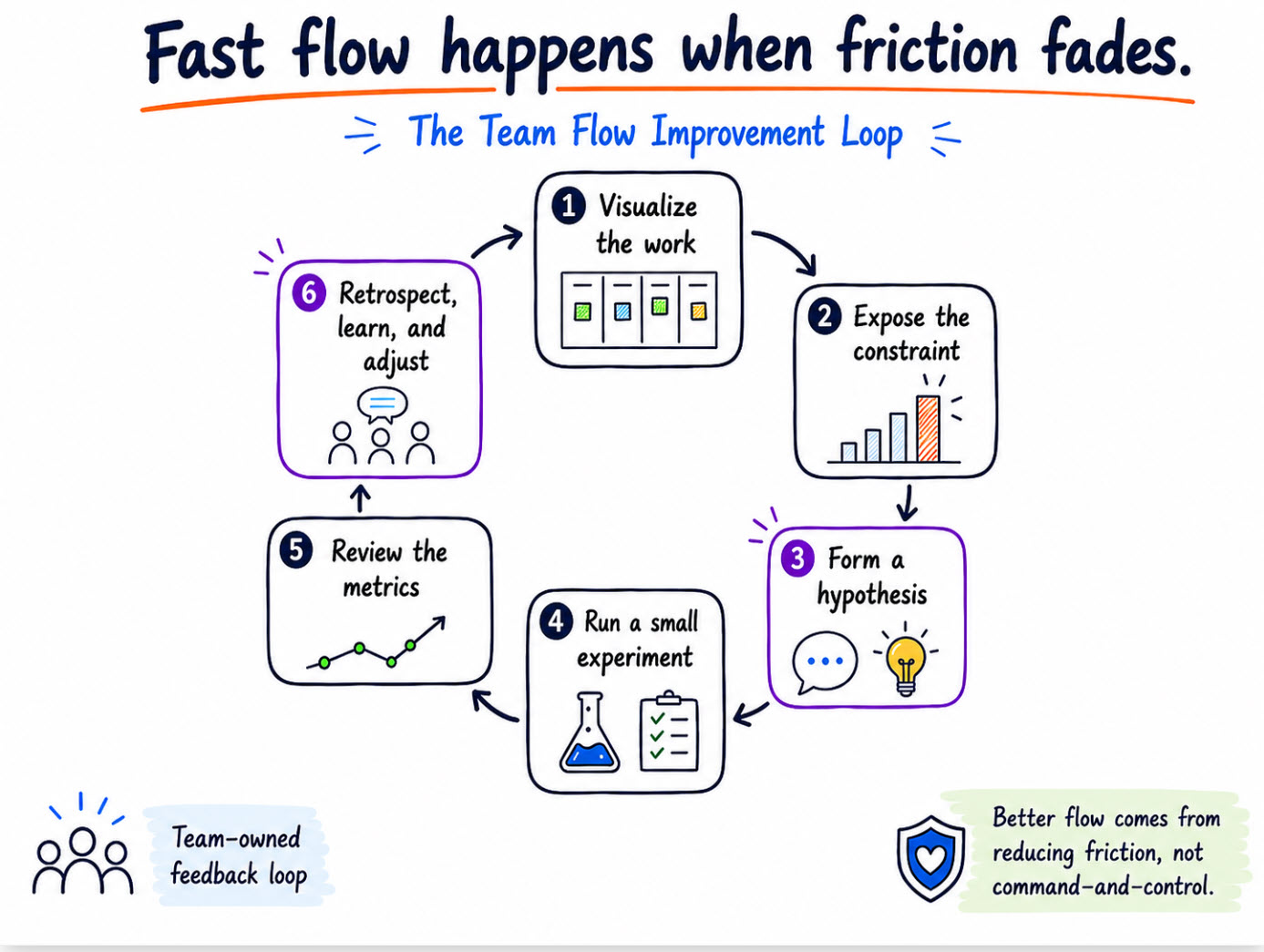
  1. Make the work visible – Map how work moves, using both our existing metrics and AI to visualize queues, wait states, and handoffs.
  2. Identify what’s slowing it down – Use flow metrics like cycle time, WIP, and throughput to find constraints before applying AI.
  3. Align stakeholders – AI can synthesize input from OKRs, roadmaps, and feedback, so we’re solving the right problems.
  4. Prototype solutions quickly – Targeted, small-scale AI experiments validate whether a constraint can be relieved before scaling.

Role-by-Role AI Adoption Across the Value Stream

AI isn’t just for software engineers, it benefits every role on your cross-functional team. Here are just a few examples of how it can make an impact. There are many more ways for each role than listed below.

Product Managers / Owners

  • Generate Product Requirements Documentation
  • Analyze customer, market, and outcome metrics
  • Groom backlogs, draft user stories, and acceptance criteria.
  • Summarize customer feedback and support tickets.
  • Use AI to prepare for refinement and planning.

QA Engineers

  • Generate test cases from acceptance criteria or code diffs.
  • Detect coverage gaps and patterns in flaky tests.
  • Summarize PR changes to focus testing.

Domain Architects

  • Visualize system interactions and generate diagrams.
  • Validate design patterns and translate business rules into architecture.

Platform Teams

  • Generate CI/CD configurations.
  • Enforce architecture and security standards with automation.
  • Identify automation opportunities from delivery metrics.

InfoSec Liaisons

  • Scan commits and pull requests (PRs) for risky changes.
  • Draft compliance evidence from logs and release data.

Don’t Forget the Extended Team

Sales, marketing, legal, and finance all influence the delivery flow. AI can help here, too:

  • Sales: Analyze and generate leads, summarize customer engagements, and highlight trends for PMs.
  • Marketing: Draft launch content from release notes.
  • Legal: Flag risky language, summarize new regulations.
  • Finance: Model ROI of roadmap options, forecast budget impact.

Risk and Resilience

What happens when AI hits limits or becomes unavailable? Inference isn’t free; costs will rise, subsidies will fade, and usage may be capped. Do you have fallback workflows, maintain manual expertise, and measure AI’s ROI beyond activity? Another reason for us to gain experience with these tools is to improve our efficiency and understand usage patterns.

The Opportunity

We already have the data to see how our system performs. The real opportunity is to aim AI at the constraints those metrics reveal, removing friction, aligning teams, and improving decision-making. If we take the time to learn the tools now, we’ll be ready to use them where they matter most.

What Now?

We already have the metrics to see how our system performs. The real opportunity is to apply AI purposefully across the full lifecycle, from ideation and design, through development, testing, deployment, and into operations and business alignment. By directing AI toward the right constraints, we eliminate friction, unify our teams around clear metrics, and elevate decision-making at every step.

Yes, AI adoption is a learning journey. We’ll stumble, experiment, and iterate, but with intention, measurement, and collaboration, we can turn scattered experiments into a sustained competitive advantage. AI adoption is about transforming or improving the system itself.

AI isn’t failing, it’s maturing. We’re on the rise of the adoption curve. Our challenge and opportunity is to build the muscle and culture to deploy AI across the lifecycle, turning today’s experiments into tomorrow’s engineered advantage.

For anyone still hesitant, know this: AI isn’t going away. Whether it slows us down or speeds us up, we must learn to use it well, or we risk being left behind. Let’s learn. Let’s measure. Let’s apply AI where it’s most relevant and learn to understand its current benefits and limitations. There’s no going back, only forward.

Poking Holes

I invite your perspective on my posts. What are your thoughts?

Let’s talk: phil.clark@rethinkyourunderstanding.com


References

Afterburnout. (n.d.). AI promised efficiency. Instead, it’s making us work harder. Afterburnout. https://afterburnout.co/p/ai-promised-to-make-us-more-efficient

Clark, P. (2025, July). AI is improving software engineering. But it’s only one piece of the system. Rethink Your Understanding. https://rethinkyourunderstanding.com/2025/07/ai-is-improving-software-engineering-but-its-only-one-piece-of-the-system/

METR. (2025, July 10). Measuring the impact of early-2025 AI on experienced open-source developer productivity. METR. https://metr.org/blog/2025-07-10-early-2025-ai-experienced-os-dev-study/

Pereira, S. (2025, August 8). It’s time for AI to meet flow: Flow engineering for AI. Steve Pereira. https://stevep.ca/its-time-for-ai-to-meet-flow/

State of DevOps Research Program. (2024). 2024 DORA report. Google Cloud / DORA. (Direct URL to the report as applicable)

Tacho, L. (2025, June). How to cut through the hype and measure AI’s real impact. Presentation at LeadDev London.  https://youtu.be/qZv0YOoRLmg?si=aMes-VWyct_DEWz0

Filed Under: Agile, AI, DevOps, Leadership, Metrics, Product Delivery, Software Engineering, Value Stream Management

  • Go to page 1
  • Go to page 2
  • Go to page 3
  • Interim pages omitted …
  • Go to page 5
  • Go to Next Page »

Copyright © 2025 · Rethink Your Understanding

  • Home
  • Mission
  • Collaboration
  • AI
  • Posts
  • Podcast
  • Endorsements
  • Resources
  • Contact